Big News for Primary Care in CMS Proposed 2025 Physician Fee Schedule: Advanced Primary Care Management Codes The National Academies of Sciences, Engineering, and Medicine (NASEM) landmark 2021 report, Implementing High-Quality Primary Care identified a listing of policy changes that are needed if we are serious about strengthening primary care. Hats off to CMS leadership for doing the hard work of starting to incorporate the NASEM guidance on evolving primary care reimbursement toward hybrid primary care payment. In the proposed 2025 Physician Fee Schedule, CMS introduces three proposed new Advanced Primary Care Management codes (APCM)– a big step toward hybrid payment reform for Medicare FFS. Read more here
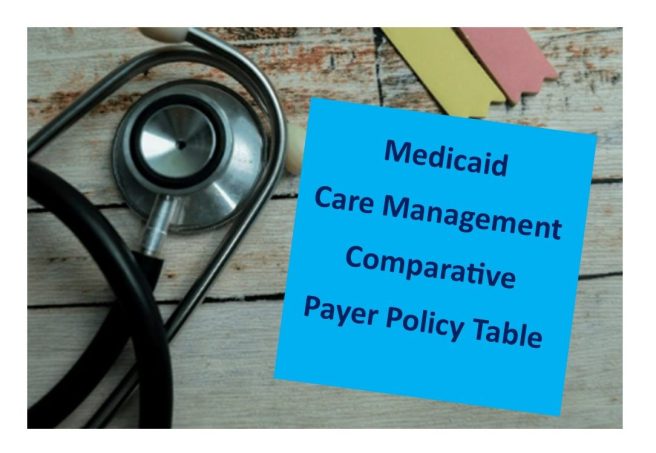
Medicaid Care Management Comparative Payer Policy Table We’ve heard from practices that sometimes it is difficult to understand plan policies about Medicaid care management. They tell us that they have a much clearer understanding of policies for patients covered by commercial and Medicare plans. So we worked with Medicaid Health Plans to describe their care management policies and have captured the results in a new comparative policy table. Read more here
The CMS Proposed 2025 Physician Fee Schedule Explained Each year, MMI reads the proposed Physician Fee Schedule (PFS) draft for the upcoming year when CMS releases it to distill the items that are most pertinent to primary care and population health. We’ve created a “topnotes” PPT deck summary of the 2025 PFS for you. Read more here
Healthy Community Zones RFP to Be Released Later in Fall On behalf of the Michigan Department of Health and Humans Services (MDHHS) Physical Activity and Nutrition Unit, we are excited to announce the upcoming Request for Proposals (RFP) for Healthy Community Zones. Read more here

MMI Steering Committee Helping to Shape the Future Federal Direction for Primary Care Policy The Steering Committee of Michigan Multipayer Initiatives (MMI) is a collective group of leaders that represent primary care practices, Physician Organizations, payers, and community-based organizations. Recently, in response to a Request for Information (RFI) from CMS included in the 2025 proposed Physician Fee Schedule (PFS) release, the MMI Steering Committee worked together to compose a comment letter to CMS with thoughtful observations and suggestions for shaping future policy. Read more here

MiHIN Issues New Tools to Assist with the Transition to the SDoH v.4 Use Case In the interest of facilitating a seamless transition to the new SDOH (Social Needs Screening) Use Case file specification (v4.0), MiHIN has developed resources to help all submitting organizations successfully transition to the latest file specification by December 15, 2024. Read more here

We’re introducing a new Journal Club section of the Primary Care Review with the goal of distilling the best of the recently published literature, realizing that your time is scarce. The Journal Club section will share the best of what we’re reading about strengthening primary care and population health. We’re starting this month with four articles worth reading.
Proposed Medicare Fee Schedule Brings Important New Tools to Primary Care: Has CMS Nailed It? | Milbank Memorial Fund
The Advanced Primary Care Management (APCM) codes that CMS proposed in the 2025 Physician Fee Schedule (PFS) are big news. The new codes work within the FFS foundation of the PFS in a creative way by creating bundled payments for the behind the scenes and patient-facing work of comprehensive care management. The proposed rule does not require time-tracking, and the bundled payments have three levels to cover the array of patients – from those without chronic illness to those who are highly complex. CMS did the best they could within the statutory constraints that are inherent to the design of Traditional Medicare, like the 20% coinsurance provision. Even though most Traditional Medicare beneficiaries have Medigap that would protect them from paying the coinsurance, about 10% do not. Will this be a rate-limiter in practices using the new codes? Time will tell, and this article encourages us to not let the perfect be the enemy of the good.
Out Of Balance: Fixing Our Health System’s Neglect Of Primary Care
You know you’ve got something when national thoughtleaders from different organizations align on a common path forward. The Commonwealth Fund, Milbank Fund, and Arnold Ventures all submitted individual responses to the Senate Finance Committee’s information request on how to improve care for those with chronic conditions. Their responses had three things in common. This piece explores the common themes and policy actions that relate to each.
Vermont All-Payer ACO Model: Evaluation of the First Five Years
Fifteen times as many people live in Michigan than live in Vermont. There is good reason, however, to be attentive to the Granite State’s experience with value-based care and payment. Vermont has had an All-Payer ACO Model for over five years, which has had robust payer participation (Medicare, Medicaid and commercial). CMS engaged researchers at NORC at the University of Chicago to evaluate the first five years of the All-Payer ACO model. The results are in and they are promising.
The Failing Experiment Of Primary Care As A For-Profit Enterprise
Three members who serve on the National Academy of Sciences, Engineering, and Medicine’s (NASEM) Standing Committee on Primary Care reflect on the trend in the last decade of investor-owned corporations buying primary care practices and the use of venture capital to establish alternatives to traditional primary care. When they look at the landscape of primary care in 2024, they conclude that there has been quite a scaling back of corporate investment into primary care. This isn’t surprising to many – especially those on the front lines who were hard at work meeting their patients’ needs before the corporate actors entered. In this article, the authors consider regulating corporate and private equity ownership and urge more assertive public policy that places the needs of the patient above other considerations.
Training Corner puts the learning opportunities across the state related to care management and population health together in one spot. See the latest Read more here
 Michigan Multipayer Initiatives